


WELCOME
RSAM is a handler-centered technique that uses resonance (calm, coherent energy states) to regulate both handler and animal. It enables animals to operate off-leash, remain responsive under stress, and synchronize naturally with the handler’s intent. This site is meant to be a DIY, self-help kind of guide, so you can heal trauma and train your pets!
What RSAM Feels Like in Practice
RSAM is easiest to understand through what actually changes between a person and their dog.
When the handler’s nervous system settles — breath slows, posture softens, attention becomes steady — the dog often settles too. The connection holds without constant verbal commands or physical correction. The dog can stay oriented to the handler even when the environment is busy. Off-leash work becomes possible not because the dog has been forced into obedience, but because the two nervous systems are moving in the same direction.
People who work this way commonly notice:
- The dog’s body softens and stays closer without being asked
- Rear-cover (“watch my six”) becomes more reliable and less effortful
- Startle responses decrease for both handler and dog
- The dog recovers focus faster after distractions
- Public outings feel less draining because constant scanning is no longer required
A typical moment might look like this:
A handler is walking through a store. Someone passes close behind. Instead of the handler’s body locking up and the dog breaking position, both remain oriented. The dog gives a quiet notice and stays in cover. The handler feels the information, adjusts if needed, and keeps moving. No escalation. No struggle. Just a shared, regulated field.
Over time, many handlers notice that “clear, settled intent itself” becomes a more reliable signal. The dog responds to what the handler needs or expects because the communication is already present in the shared field. This is one of the quieter, more advanced expressions of resonance.
The real milestone
The true reward of this method is the off-leash experience that becomes possible when that shared field is stable. The dog stays with you, responsive and calm, because the connection is already clear. No leash is required to hold the relationship. That level of freedom and mutual regulation is what the practical training pathway on this site is built to reach.
The steps (professional referral, timeline, rear-cover drills, scent work) give you the concrete path. The resonance is what makes those steps hold under real stress and ultimately allows the off-leash connection to become natural.
Introduction
Professional Referral –
A professional referral is the foundation of any legitimate Guide Certification process with the Resonant Service Animal Method.
As a trainer a referral is used to clearly understand the specific functional limitations the handler experiences and the precise tasks the animal must be trained to perform. This protects both the handler and the public. It ensures we are addressing a genuine, documented need related to C-PTSD or similar Complex-trauma-based disabilities—most often the need for continuous off-leash rear awareness (“watch my six / cover”) so the handler can remain oriented, stable, and functional in public environments.
The referral also serves as an important safeguard. Off-leash work is an advanced skill that demands exceptional reliability, calm focus, and a deep working partnership. It is never appropriate as a display of control, status, or as any form of protective or aggressive tool directed at the public.
Service animals under this method are trained only for non-aggressive, disability-mitigating tasks. Any request that appears driven by ego, image, or a desire for an “off-leash weapon” will not be accepted into the training pathway.
Finally, the referral helps confirm that a real connection already exists—or is ready to be developed—between the handler and the animal. The Resonant Service Animal Method relies on mutual regulation and attunement. Without a genuine bond and a clear therapeutic purpose, the advanced skills (including sustained off-leash cover) cannot be trained safely or effectively.
Please have your licensed mental-health provider or physician complete the referral using the guidelines below. Once received, we can begin the individualized training plan with clarity, safety, and purpose.
This is general public knowledge, not a substitute for professional guidance, veterinary assessment, or individualized work with a qualified trainer experienced in psychiatric service dogs.
Under the ADA (U.S.), no formal certification or professional program is required—the dog must be individually trained to perform specific tasks that mitigate the handler’s disability, and it must behave appropriately in public.
Emotional support alone (mere presence/comfort) does not qualify.
1. Foundation: Dog Selection and Handler Preparation
- Choose a dog with stable temperament, low reactivity, high trainability, focus on the handler, and resilience to novelty/noise. Common successful breeds/mixes include Labrador Retrievers, Golden Retrievers, Standard Poodles, and some carefully evaluated mixed/rescue dogs. Avoid high-prey-drive or sound-sensitive dogs for most PTSD work.
- Confirm the dog is healthy (vet clearance, including hips, eyes, temperament testing if possible).
- Handler side: Work with a mental-health professional to identify specific functional limitations (e.g., hypervigilance in crowds, flashbacks, nightmares, dissociation). Document the disability if needed for other contexts, though ADA public access does not require paperwork.
- Establish a strong bond through daily care, play, and calm co-presence before formal training.
2. Basic Obedience and Manners (Months 1–4/6)
Master these to high reliability (near 100% in low distraction, then with progressive distraction):
- Sit, down, stay (duration + distance), come/recall, heel/loose-leash walking, leave-it, drop-it, place/settle.
- Impulse control games (e.g., wait for food/toys).
- Body awareness and confidence-building exercises.
- Use short, frequent sessions (5–15 minutes, multiple times daily). Generalize to different rooms, then yards, sidewalks, and quiet parks.
Many programs recommend reaching Canine Good Citizen (CGC) or equivalent reliability as a milestone before heavy public work.
3. Public Access / Neutrality Training (Overlaps with Phase 2, Months 4–12+)
Goal: Calm, focused, non-disruptive behavior in real-world environments so the dog can work while the handler stays stable and aware.
- Progressive exposure: Start in low-distraction settings (quiet stores during off-hours), then restaurants, elevators, transit, crowds, medical facilities.
- Key skills: Settle under tables/chairs for extended periods; ignore food on floors/tables; ignore other dogs/people/noise; four-paws-on-floor greetings; calm vehicle loading; no vocalizing or scavenging.
- Practice “Look at That” or "What was that" or similar; to turn distractions into check-ins with the handler.
- Build duration and distance gradually. Proof under stress (sudden noises, people approaching from behind). Assistance Dogs International-style Public Access Tests are useful self-assessment benchmarks (not legally required).
4. PTSD-Specific Task Training (Months 6–18+, after solid foundations)
Select 2–6 tasks that directly address the handler’s symptoms.
Train one or two to high reliability first. Shape behaviors with successive approximations, capture natural responses, and add a clear cue.
Common, trainable tasks for PTSD (especially public stability and awareness):
- Deep pressure therapy (DPT) / grounding: Dog lies across lap, chest, or legs on cue (or in response to rising distress signals) to provide calming pressure and interrupt panic/flashbacks/dissociation.
- Anxiety/panic interruption: Dog notices pre-episode cues (breathing changes, rocking, etc.) and nudges, paws, or leans persistently until the handler responds.
- Crowd buffering / blocking / cover: Dog positions itself between handler and others (front, side, or rear) to create physical space and reduce startle/hypervigilance in lines, stores, or transit.
-Room search / perimeter check / “clear”: On cue, dog enters a space first, sweeps it, and signals “all clear” (sit, return, specific behavior). Helps reduce hypervigilance when entering unfamiliar places.
-Nightmare / night-terror interruption: Dog detects restlessness/vocalization and wakes the handler with a nudge or lick.
- Additional options: Guide to exit when overwhelmed; medication reminder/retrieval; tactile reality-testing during dissociation; “watch my back” positioning.
For veterans with combat-related trauma, room-clearing, rear-cover, and crowd work often prove especially useful for public functioning. Shape these carefully so the dog remains calm and non-aggressive.
Practice tasks first at home, then layer them into public environments. Simulate mild triggers under controlled conditions only after foundations are solid, and never overwhelm the dog or handler.
5. Integration, Proofing, and Maintenance
- Combine obedience + public manners + tasks in realistic scenarios (shopping, appointments, transit).
- Maintain daily short training sessions and mental enrichment.
- Monitor for burnout in dog or handler; adjust intensity.
- Optional: Work with a professional service-dog trainer for feedback, especially on advanced public access or complex alerts. Many veteran programs (e.g., those using rescue dogs or residential pairing) follow similar phased structures.
Important Legal and Practical Notes
- ADA public access applies once the dog is task-trained and under control. Businesses may ask only two questions: (1) Is this a service animal required because of a disability? (2) What work or task has the dog been trained to perform?
- No vest, ID, or registration is required (though many handlers use them for convenience).
- Airlines and housing have additional rules (Air Carrier Access Act, Fair Housing Act).
- Success depends heavily on the individual dog–handler team. Some trauma responses may not suit certain physical tasks (e.g., intense pressure); customization is essential—this aligns with your observation about proprietary, veteran-specific experience.
Revised Compact Schedule & Timeline for a 24/7 Handler
(Optimized for continuous proximity — every ordinary movement becomes practice)
Overall Target: 10–14 months to reliable off-leash “Cover / Watch My Six” in typical public environments.
Assumes an adult dog with good temperament and basic house manners already in place.
Phase 1: Foundations (6–10 weeks)
Daily rhythm (woven into normal life):
- Morning: 2–3 micro-sessions (30–60 seconds) while making coffee or getting dressed — shape rear position against a wall or furniture.
- Midday: Practice while walking from room to room or standing at the sink.
- Evening: 1–2 longer holds (build to 1–2 minutes) while watching TV or reading.
- Cue introduction: Once the dog offers the position reliably, add the verbal cue “Cover” or “Six.”
Milestone to advance: Dog moves into rear position on cue and holds for 90+ seconds while the handler stands or takes a few slow steps indoors. Reliable recall and basic stay in the home.
Phase 2: On-Leash Cover + Daily Public Exposure (3–5 months)
Daily rhythm:
- Every necessary outing (mailbox, store, appointment, short walk) is a training opportunity.
Start the outing in heel, then cue “Cover.” Reward heavily at first for staying behind.
- At home: Continue micro-practice during any standing or walking activity.
- 3–4 times per week: Deliberately choose a slightly busier environment (quiet store during off-hours, sidewalk with light foot traffic) and practice longer stretches of cover.
- Add the alert piece: When someone approaches from behind, mark and reward any calm body-language change or subtle lean the dog offers.
Milestone to advance: Dog maintains cover for full short public outings (5–10+ minutes) on leash with good reliability in moderate settings. Handler can drop the leash briefly and the dog stays in position or returns immediately.
Phase 3: Distraction Proofing + Controlled Off-Leash (3–4 months)
Daily rhythm:
- Continue using every real outing for cover practice.
- 2–3 times weekly: Controlled off-leash or long-line work in safe outdoor spaces (fenced yard, quiet park path, empty parking lot). Cue “Cover,” walk, reward for staying behind without physical connection.
- Increase natural distractions gradually (people passing, other dogs at a distance, sudden noises).
- At home: Practice cover while the handler is engaged in conversation or looking at a phone so the dog learns to hold position without constant visual attention.
Milestone to advance: Dog holds cover off-leash (or on long line) for several continuous minutes in quiet outdoor public areas under voice control. Reliable response even with moderate distractions.
Phase 4: Full Off-Leash Public Reliability (3–5 months)
Daily rhythm:
- Primary training is real life. Use the task on every outing where rear awareness is needed.
- Short formal proofing 2–3 times per week in busier environments (stores, transit platforms, outdoor gathering spots).
- Maintain strong recall and recovery: if the dog drifts, call it back into cover immediately and reward.
- Weekly maintenance: Brief indoor refresher + one higher-distraction outing.
Completion criteria:
- Dog maintains continuous rear cover for 15–30+ minute public walks under voice/signal control with high reliability across varied settings.
- Calmly alerts (via body language or subtle contact) to close rear approaches without aggression or breaking position.
- Handler has full control; dog recovers focus quickly if distracted.
- Team can demonstrate the skill + general public manners in everyday environments.
Notes for the 24/7 Advantage
- Micro-sessions (seconds to a couple of minutes) scattered throughout the day often produce faster, more durable learning than formal hour-long blocks.
- Because the dog is always present, the handler can reinforce the position hundreds of times in low-pressure moments before ever asking for it under stress.
- Progress is measured by real-world performance on actual needed outings rather than by artificial drills.
When a handler lives with the dog 24/7 (the typical situation for someone whose disability requires continuous support), the timeline can be meaningfully streamlined. The constant proximity creates far more natural practice opportunities than scheduled sessions alone. Every short walk to the mailbox, every time the handler stands at the kitchen counter, every quiet evening in the living room becomes low-stakes repetition. That consistency often compresses the overall calendar while still producing high reliability.
Streamlined Timeline for a 24/7 Handler
Assuming the dog already has solid basic manners and the handler can practice informally throughout the day:
1. Foundations | 6–10 weeks | Basic obedience + initial rear positioning | Multiple micro-sessions daily (30–60 seconds each) while doing ordinary household movements
2. On-leash Cover + Early Public | 3–5 months | Generalize the “Cover / Six” position into real daily outings | Practice on every necessary trip (grocery, appointments, short walks). Real-life duration builds faster than formal drills
3. Distraction Proofing + Controlled Off-Leash | 3–4 months | Strengthen reliability and introduce brief off-leash work in safe settings | Use long-line work during ordinary outdoor time; incorporate natural approaches from people in daily environments
4. Full Off-Leash Public Reliability | 3–5 months | Continuous rear cover under voice control in typical public settings | Daily real-world use becomes the primary training. Formal “sessions” shrink to short maintenance and proofing |
Realistic total for a motivated 24/7 team with a suitable adult dog: 10–14 months, to reach high-reliability off-leash cover in public, versus the 16–20-month general estimate. Some teams move faster; others need the full range depending on the dog’s temperament and the intensity of the handler’s symptoms.
Role of Professional Referral
A professional referral (from a treating physician, psychiatrist, psychologist, or other licensed mental-health provider) is often the practical foundation people use when they create their own documentation or internal “certification” process.
Under the ADA there is still "no legal requirement" for any formal certification, registration, or letter for public access. However, many handlers keep a concise letter on file because:
- It documents the disability-related need.
- It supports housing or airline requests if those arise.
- It gives the handler confidence and a clear written record of the tasks the dog is trained to perform.
Phase Approximate Duration Focus Notes for 24/7 Acceleration
1. Foundations 6–10 weeks Basic obedience + initial rear positioning Multiple micro-sessions daily (30–60 seconds each) while doing ordinary household movements.
2. On-leash Cover + Early Public 3–5 months Generalize the “Cover / Six” position into real daily outings Practice on every necessary trip (grocery, appointments, short walks). Real-life duration builds faster than formal drills.
3. Distraction Proofing + Controlled Off-Leash 3–4 months Strengthen reliability and introduce brief off-leash work in safe settings Use long-line work during ordinary outdoor time; incorporate natural approaches from people in daily environments.
4. Full Off-Leash Public Reliability3–5 months Continuous rear cover under voice control in typical public settings. Daily real-world use becomes the primary training. Formal “sessions” shrink to short maintenance and proofing.
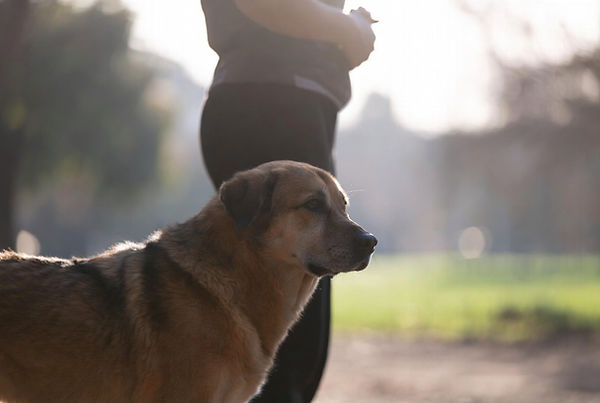

A service dog working in public will face two very different kinds of human interaction. Both need to be trained for.
1. Friendly / Curious Public
People (especially parents with children and owners of leashed dogs) often see a calm, well-behaved dog and assume it is available for petting or social interaction.
Training goals for the dog:
- Remain in working position (cover, heel, or settle) when strangers approach.
- Ignore hands reaching toward it, voices calling it, and other dogs on leash.
- Show no solicitation (no moving toward people, no soliciting pets).
- Recover focus immediately if briefly distracted.
Handler skills to practice:
- A short, polite but firm decline: “He’s working right now, please don’t pet him.”
- Body positioning that creates a gentle barrier if needed.
- Continuing to move or remaining oriented so the interaction does not become prolonged.
Safe drills:
- Have helpers’ approach, ask to pet, reach toward the dog, or bring a calm leashed dog nearby.
- Reward the dog heavily for staying in position and ignoring the approach.
- Practice the handler’s verbal decline until it feels natural and low-arousal.
2. Confrontational / “Hall Monitor” Public
Some people will challenge an off-leash service dog, cite local leash laws, demand proof, or try to insert themselves as enforcers.
Training and preparation goals:
- Dog remains calm and task-focused even if voices are raised or people move in close.
- Handler stays regulated and does not escalate.
- Handler knows the exact legal ground (ADA: voice or signal control is allowed when a leash would interfere with the work; no certification or vest is required).
Practical handler responses that work well:
- Short, neutral statements only:
“This is a service dog under the ADA. He is under voice control.”
“I’m not required to show documentation.”
Then disengage and continue moving if possible.
- Avoid debating, educating at length, or matching the other person’s emotional intensity.
- If the person becomes aggressive or blocks movement, prioritize leaving the area safely.
Drills:
- Role-play raised voices, demands for “papers,” or people stepping in front of the team.
- Practice the dog holding cover or heel while the handler delivers a short script and continues walking.
- Build the dog’s ability to stay soft and oriented even when the handler’s voice or posture changes under mild pressure.
Why this stage matters for certification
An off-leash RSAM dog must demonstrate that the connection holds under real public pressure — both the friendly kind that tries to pull the dog out of work and the confrontational kind that challenges the handler’s right to be there. The dog’s job is to stay regulated and responsive to the handler. The handler’s job is to manage the human side with clarity and minimal escalation.
This is the final real-world proof that the resonance and training are solid enough for public access.
Public Interaction Skills – Final Stage Training Outline
(Ready for the Guide Certification)
An off-leash RSAM service dog must remain task-focused and regulated when the public approaches. There are two main types of interaction the team will face. Both need deliberate practice.
1. Friendly / Curious Approaches
People (parents, children, other dog owners) often want to pet or talk to a calm, well-behaved dog.
Dog goals
- Stay in working position (cover, heel, or settle)
- Ignore reaching hands, voices, and other dogs on leash
- Show no solicitation or movement toward the person
- Recover focus immediately if briefly distracted
Handler skills
- Short, polite decline: “He’s working right now, please don’t pet him.”
- Calm body positioning that gently creates space if needed
- Ability to keep moving or stay oriented so the interaction does not drag on
Practice drills
- Helper’s approach, ask to pet, reach toward the dog, or bring a calm leashed dog nearby
- Reward the dog heavily for remaining in position and ignoring the approach
- Practice the verbal decline until it feels natural and low-arousal
- Gradually increase the friendliness and persistence of the helpers
2. Confrontational / “Hall Monitor” Approaches
Some people will challenge the off-leash status, cite local leash laws, demand proof, or try to intervene.
Dog goals
- Remain calm and task-focused even if voices are raised or people move in close
- Hold cover or heel without reacting to the emotional intensity of the situation
Handler skills
- Stay regulated and do not escalate
- Use short, neutral statements only:
- “This is a service dog under the ADA. He is under voice control.”
- “I’m not required to show documentation.”
- Disengage and continue moving when possible
- Know the legal ground (ADA allows voice or signal control when a leash would interfere with the work; no certification or vest is required)
Practice drills
- Role-play raised voices, demands for “papers,” or people stepping into the team’s path
- Practice the dog holding position while the handler delivers a short script and continues walking
- Build the dog’s ability to stay soft and oriented even when the handler’s voice or posture changes under mild pressure
Completion Standard for This Stage
The dog remains in working position and recovers focus quickly during both friendly and confrontational approaches. The handler can manage the human interaction with clarity and minimal escalation. The shared field holds under real public pressure.
This stage confirms that the off-leash connection is reliable enough for everyday public access.
The field is live on
Weekly challenges & co-breathed notes →


LEGITIMATE REAR COVER DRILLS FOR SERVICE ANIMALS
Important boundary first
“These drills are built on fairness and mutual limits".
"The dog is never required to escalate or confront. The human always retreats fully when the dog offers an early, calm signal. This gives the dog clear agency and teaches that soft communication is effective. The goal is reliable, low-arousal information for the handler—not control over other people.”
In legitimate psychiatric service-dog work (including rear cover / “watch my six” for C-PTSD), the dog’s role is detection and information only. The dog notices an approach from behind and gives the handler a calm, trained signal so the handler can decide what to do.
It is not trained for threat deterrence, confrontation, guarding, or any form of aggression toward people. Training a dog to deter, block aggressively, bark at, or intimidate strangers takes it out of the service-dog category under the ADA and creates serious legal, safety, and public-access risks.
"That kind of work belongs to protection or personal-protection dogs, which are a completely different category and do not have the same public-access rights".
Everything below stays strictly inside non-aggressive, positional, informational work.
Legitimate “Detection” in Rear-Cover Work
The only appropriate form of detection is:
- The dog notices a person approaching from the rear or side-rear.
- The dog gives a calm, previously trained signal (subtle body-language shift the handler can feel, a soft lean, a brief nose touch to the handler’s leg, or a quiet sit/stand change).
- The dog remains in or returns to the cover position and does not move toward, stare down, bark at, or otherwise engage the approaching person.
The signal exists solely so the handler is not startled. The dog never becomes the “deterrent.”
Safe Drills for Stranger-Approach Awareness
These drills build the dog’s ability to notice rear approaches and give a calm signal while staying in cover. All drills use positive reinforcement only. No aversive, no confrontation.
1. Static Rear Approach (beginner)
Handler stands still with the dog already in cover position (on leash or long line at first). A helper walks slowly from behind at a comfortable distance, passes, and continues. Mark and reward the dog the moment it notices the helper (ear flick, head turn, body tension the handler can feel) "without" leaving position or reacting. Repeat with gradually closer passes.
2. Walking Rear Approach
Handler walks with the dog in cover. Helper approaches from behind at a walking pace, passes on one side, then fades. Mark the dog’s notice while it stays in position. Build duration and reduce the distance of the pass over many sessions.
3. Multiple Passers
In a quiet public or semi-public setting, practice while ordinary people walk past from behind. Reward the dog for noticing and remaining calm in cover. This generalizes the skill to real environments.
4. Recovery Drill
Deliberately allow the dog to drift slightly, then cue it back into cover the moment a helper appears from behind. This strengthens the habit of returning to the working position instead of investigating.
5. Distance and Angle Variation
Practice approaches from slightly off-center (5–7 o’clock and 5–7 o’clock positions) so the dog learns to notice people who are not directly behind.
Always end sessions on success. Keep the dog’s arousal low. If the dog begins to stare, stiffen, or move toward the helper, increase distance and reinforce calm noticing instead.
Useful Role-Playing Guidelines (Handler + Helper)
Role-play is valuable, but it must stay ethical and non-aggressive:
- The helper’s job is only to approach calmly from behind and pass by. No sudden lunges, no yelling, no “threat” acting.
- The handler focuses on feeling the dog’s signal and remaining regulated. The handler does **not** practice confronting the helper.
- Start with known, trusted helpers. Only later introduce unfamiliar but still cooperative people.
- Never reward the dog for any behavior directed at the helper (barking, lunging, blocking the path, hard staring).
- Keep sessions short. The goal is a quiet, reliable notice—not an excited or protective response.
- After the drill, give the dog a clear “all clear” or release cue and reward calm settling.
Why Deterrence Training Is Not Appropriate Here
- It changes the dog’s job from information provider to confrontational actor.
- It increases the risk of the dog becoming reactive or aggressive in public, which can result in loss of public-access rights and liability.
- For someone with C-PTSD, an aggressive or highly aroused dog can actually escalate the handler’s own nervous-system activation instead of reducing it.
- True security for the handler comes from reliable information + the handler’s own ability to choose a response (leave, create space, ask for help, etc.), not from the dog deterring people.
If a handler’s situation genuinely requires personal protection beyond informational awareness, that need should be addressed through human security measures, self-defense training, or a separately trained protection dog that is not presented as a service animal. Mixing the two roles’ compromises both.
The drills and role-plays above stay cleanly inside service-dog standards: calm detection, positional reliability, and support for the handler’s regulation. They can be added to the self-help section of the site with the same clear boundaries stated upfront.
Safe 100% Retreat Drill for Rear-Cover / Notice Work
This drill builds the dog’s confidence that noticing an approach is safe and effective. The dog sets a comfortable distance through calm body language. The human always respects that distance by retreating fully and immediately. The dog never has to escalate, confront, or control the person. The result is a clear, mutual understanding of limits based on fairness and the dog’s agency.
Core Principles
- The dog’s early, soft signals are the boundary.
- The human does 100% of the retreating.
- The dog is reinforced for calm noticing and for remaining in (or returning to) the cover position.
- No high-value resources are used.
- Arousal stays low. Intensity is never rewarded.
- The dog retains full choice and control over its own behavior.
How to Run the Drill
Setup
- Handler has the dog in the cover position (on leash or long line at first).
- A trusted helper stands at a comfortable starting distance behind or slightly off-center.
- Handler is calm and attentive to the dog’s body language.
Sequence
1. Helper begins a slow, neutral approach from behind.
2. The moment the dog shows an early notice signal (ear flick, soft head turn, mild body tension the handler can feel, or a quiet shift in weight), the handler marks it (“Yes” or click).
3. Helper immediately stops and retreats fully, using a soft, non-threatening posture (slightly lowered head/shoulders, turning the body away, relaxed movement).
4. Handler rewards the dog generously for the calm notice and for staying in (or returning to) the cover position.
5. Pause. Let the dog settle. Repeat only when both dog and handler are soft again.
Progression
- Begin with larger distances and slower approaches.
- Gradually reduce the starting distance only as the dog remains consistently soft and the notice stays early and quiet.
- Move from stationary practice to walking cover.
- Eventually practice with ordinary people in real environments (still marking the early notice and ensuring the “approach” resolves without pressure on the dog).
What Success Looks Like
- The dog notices early and stays relaxed.
- The dog does not stiffen hard, stare, vocalize, or move toward the person.
- The dog learns that a soft signal is enough — the situation resolves, and good things follow.
- Over time the dog becomes more confident and precise in its notice while remaining low-arousal.
Supporting Consent-Based Distance Work
Between formal rear-cover drills, practice simple consent approaches in neutral contexts:
- Walk toward the dog’s resting space or personal area.
- Stop and increase distance at the first soft discomfort signal (look-away, lip lick, subtle lean away).
- Reward the dog for remaining soft.
- This reinforces the same message: mild signals are heard and respected, so stronger warnings are unnecessary.
Drills for Scent Work
Scent Work – Bone Hide Method
This simple scent exercise builds a strong searching drive using something dogs already love. It requires no special equipment and works with one dog or several.
How the Method Works
1. Take one or more dog bones (or other high-value chews) and hide them in different locations while the dogs are in another area or secured.
2. Walk back to the dogs. The residual scent left on your hands and clothing from handling the bones becomes the natural start cue.
3. As you walk past, the dogs catch that scent and understand the hunt is on.
4. Release the dogs to search. They must locate the bones by nose alone.
5. When a dog finds a bone, let it fully enjoy the reward.
The dogs learn that the specific scent on you means a valuable find is available nearby. They then switch into independent searching mode.
Basic Guidelines
- Keep sessions short and successful. Stop while the dogs are still eager.
- Start with easy hides in one or two rooms.
- Let every dog that participates get finds so no one learns to freeload.
- Always allow the dog to keep and enjoy the bone once it is found. That payoff maintains motivation.
Easy Progressions
Once the dogs are reliable on simple hides, you can increase difficulty gradually:
- Lengthen the time between hiding the bones and releasing the dogs.
- Expand the search area into multiple rooms or a secure outdoor space.
- Place bones in slightly harder spots (higher, lower, partially covered, or around corners).
- Occasionally include a “blank” hide — a location that carries your hand scent but contains no bone. This teaches the dogs to confirm the actual food odor rather than searching only for your residual scent.
- Vary the number of bones so the dogs never know exactly how many finds are available.
Optional Next Step (Alert Behavior)
If you later want a formal alert for service work, begin marking a specific behavior the dog offers when it locates the bone (a sit, stare, paw, or nose touch). Reward that behavior before releasing the bone. Over time the dog can learn to offer the same alert when it detects other target scents, including handler stress scent.
Why This Method Is Effective
It uses a natural, high-value reward the dogs already care about. The residual scent on the handler becomes a clear, consistent cue without extra verbal commands. The dogs practice independent searching, persistence, and discrimination in a low-pressure, highly reinforcing way.
This exercise can be used purely for mental enrichment or as a foundation for more formal scent detection work.
Traditional Training
vs
RSAM
Traditional Service Dog Training
Focus: Task-based support.
Method: Classical conditioning
(reward-based training).
Dogs trained to perform specific tasks:
Guiding the blind.
Alerting to sounds for the deaf.
Interrupting harmful behaviors
(self-harm, panic).
Detecting medical states
(low blood sugar, seizures).
Human-dog relationship: Hierarchical. The human is handler/master; the dog is assistant/worker.
Language: Clinical, behavioral, rooted in applied animal psychology.
Goal: Reliability, consistency, predictability. The dog should perform tasks on command or when cues are present.
RSAM (Resonant Service Animal Method=Resonant Self Alignment Method)
Focus: Emotional/spiritual co-regulation.
RSAM Method:
Builds on the idea that dogs naturally sense human trauma and nervous system states.
Instead of “command training,” the work emphasizes resonance — dogs reflecting human states and humans learning from that feedback.
Human-dog relationship: Co-equal partnership. Both beings are in a field of healing; the dog is not “working for” the human but resonating with them.
Language: Spiritual, energetic, trauma-informed.
Goal: Transformation, presence, coherence — the human and dog enter a more aligned state together.
Where they overlap
Both recognize the dogs’ sensitivity to human emotions and physiology.
Both involve training to shape how a dog responds. Both aim to improve
quality of life for the human.
Where they diverge
Traditional methods:
Task-reliability first, emotions second.
RSAM: emotions/energetics first, tasks as a natural extension.
Traditional sees the dog as a tool;
RSAM sees the dog as a partner in mutual healing.
So, RSAM is more of a philosophical expansion of what’s already known about service and therapy dogs. It pushes beyond tasks into the realm of co-healing.
Traditional Service Dog Training Session
Goal: Teach the dog to interrupt a panic attack.
Set up → Trainer has the handler simulate a panic cue.
(like rapid breathing or rocking).
Task shaping → Dog is guided to nudge the handler’s hand or place paws on lap.
Reward → Immediate treat + praise when dog performs the behavior.
Repetition → Repeat the scenario until dog automatically does the task when cue appears.
Generalization → Practice in different environments until reliable.
Focus: Consistency and obedience. Dog is trained to recognize a specific signal and perform a specific action every time.
RSAM (Resonant Service Animal Method) Training Session
Goal: Develop dog-human resonance during emotional stress.
Settle together → Human and dog sit quietly, focusing on breathing, noticing each other’s presence.
Induce mild stress → Human recalls or allows a light trauma memory/emotional wave to surface.
Observe resonance → Notice how the dog reacts naturally (shifts posture, moves closer, looks away, paws, sighs).
Amplify awareness → Human reflects back. Example: "I feel my heart racing, and my dog has leaned in closer, or perhaps moves away.”
Integration → Human lets go into the dog’s resonance — calming together. The “training” is in the mutual regulation, not commands.
Closure → End with grounding, gratitude, touch, and rest.
Focus: Presence and co-regulation. Dog isn’t commanded; its natural attunement is acknowledged and reinforced. Over time, this deepens into a repeatable, intuitive partnership.
Key Difference in Practice
Traditional: “Dog, do this when I panic.
”RSAM: “Dog, let’s be present with what arises, and together find coherence.”
One is about task performance, the other about shared state transformation.